
Music Therapy
Music and Movement Therapy Studies: The Art of Healing in Turkish Tradition
Healing with music and movement is not only a historical tradition in Turkish culture, but also a powerful healing method that finds its counterpart in modern medicine.
With over half a century of experience, TÜMATA carries this traditional approach, which was implemented in healing centers during the Anatolian Seljuk and Ottoman periods, to the present day with its applications.
These applications, developed based on the works of great scholars such as Farabi, Ibn Sina, and Gevrekzade Hafız Hasan Efendi, meticulously preserve the original forms of traditional musical therapy.


What is Music Therapy?
Music is not just an art; it is a healing language that is thousands of years old.
Ancient Turkish music is not just an aesthetically pleasing instrument, but also a healing tool that deeply impacts hearts and souls. At the heart of this tradition are human values such as understanding, faith, love, respect, struggle, and compassion .
Music therapy reminds us of our connection with nature. In the first step, we imitate the sounds of nature with pentatonic scales , attuning the body to its rhythm. Then , modal music takes us on an inner journey, touching on emotions, memories, and a heightened sense of spirituality.
This approach, now scientifically accepted, is based on a system of wisdom elaborated centuries ago by great physicians and philosophers such as Farabi, Ibn Sina, Razi, and Gevrekzade Hafız Hasan Efendi . The relationship between the maqams and emotions, organs, planets, zodiac signs, and elements is being studied with renewed interest in Turkish medicine today, as it once was.
Music therapy isn't just about listening; it's about remembering, purifying, and deepening. It's about hearing again the ancient melody that comes from the essence of humanity and the universe, the sound forgotten in the noise of modern life.

Tümata and Music Therapy
Modern Healing of Ancient Knowledge//
Founded in 1976, TÜMATA (Turkish Music Research and Promotion Group) is known for its pioneering work demonstrating that music is not only an aesthetic but also a healing tool .
TÜMATA, which conducts research into Turkish music therapy traditions through its work at the Istanbul University Ethnomusicology Center and the Marmara University Institute of Turkology, quickly became influential internationally, offering music therapy training by establishing centers in Germany, Switzerland, Spain, and Austria .
Therapeutic practices developed under the leadership of TÜMATA are considered a complementary healing method in many medical fields, including neurology, cardiology, oncology, geriatrics, and immunology . Scientific studies conducted at healthcare institutions in Vienna examined the physical and psychological effects of music using technical measurement tools such as EEG, ECG, and galvanometer . The results demonstrated that music therapy has also gained scientific validity in fields such as psychiatry, education, physical therapy, and rehabilitation .
TÜMATA's half-century of knowledge brings together traditional Turkish music, movement therapy, and Sufi teachings , not only tracing the past but also nourishing the healing fields of the future .


Pasif (Reseptif) Müzik Terapi Geleneği Seansları
Makam Musikisiyle Bireysel Şifa Yolculuğu//
Reseptif Müzik Terapi seansları, katılımcıların uzanarak ya da rahat bir şekilde oturarak müziği derin bir dinleyişle deneyimlediği, tamamen alıcı (pasif) konumda bulundukları şifa seanslarıdır. Bu geleneksel terapi yaklaşımı, “Makam Musikisi” ve “İmaj Terapisi” olmak üzere iki ana başlıkta uygulanır.
Seanslarda, Kadim Türk Müzikle Tedavi Geleneği'nin prensipleri esas alınarak, her katılımcıya özel ve tekrarı mümkün olmayan bir deneyim sunulur. Günün saatine, haftanın gününe, kişinin ihtiyacına göre uygun makam belirlenir ve bu makam üzerinde doğaçlama (emprovize) bir icra gerçekleştirilir.
Terapi Seanslarının Etkileri ve Faydaları//
Türk musikisinin makamlarının ruhsal, fiziksel ve zihinsel etkileri bin yılı aşkın süredir bilinmektedir. Her makam; duygular, organlar, elementler, burçlar ve gezegenlerle ilişkilendirilmiştir. Bu bilgiler, hem kadim kaynaklara hem de modern literatüre dayanmaktadır.
Reseptif terapi seansları:
-
Beyin dalgalarını sakinleştirir, zihinsel gevşeme sağlar.
-
Nefes ritmini düzenler, solunumu derinleştirir.
-
Stresi ve gerginliği azaltır, içsel dengeyi artırır.
-
Hareket ve beceriyi artırır, bedeni canlandırır.
-
Bağışıklık sistemini güçlendirir, dayanıklılığı destekler.
-
Sindirimi, dolaşımı ve nabzı etkiler, bedeni bütüncül olarak dengeler.
-
Kendini iyi hissetme ve ait olma duygusu yaratır.
-
Öğrenme ve hafızayı olumlu yönde etkiler.
Examples of the Healing Properties of the Maqams//
Rast Makam – Gives joy and inner peace; is effective on the head area and eyes.
Husayni Maqam – Offers a feeling of peace and gentleness; supports the immune system.
Rehavi Makam – Evokes a sense of infinity; offers deep inner clarity.
These sessions, conducted with the expertise of TUMATA, establish a natural bridge between music and the subconscious, offering a spiritual healing space to modern people under the guidance of ancient wisdom.
Music Therapy Sessions Content: In receptive music therapy sessions, the TÜMATA team employs a team of four to six people , depending on the scope of the activity. Sessions last approximately 90 minutes, including explanations and guidance.


Active Music and Movement Therapy Sessions
In the active therapy sessions of TUMATA studies, participants actively participate in dances, songs and music performed.
Within the scope of these studies
Baksi Dance
Archetypal Movements are performed.
Baksi Dance
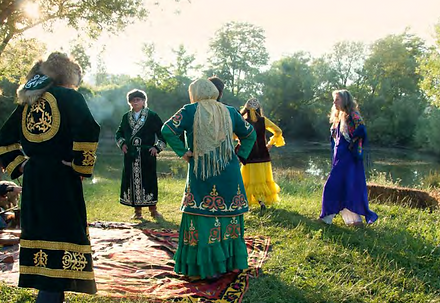
Deep in history, healers known as "Kam" and "Baksı" in Turkish communities have used music and movement as healing tools . This practice has been practiced for centuries as a form of healing aimed not only at physical ailments but also at spiritual and energetic balance.
Originating in the depths of Central Asia, this tradition has been preserved and passed down through generations, particularly by Central Asian shamans, the Baksi people . Today, the "Baksi Dance," or "Karacorga," as it is known in some regions, is considered one of the oldest healing rituals that combine music and movement.
The seminar will cover the historical roots, cultural context, and practice methods of the Baksi Dance in detail. Participants will gain both theoretical knowledge and experience the dance's fundamental elements, gaining direct contact with the spiritual and physical impact of this ancient ritual.

Archetypal Movements –
Touching the Body's Memory
Archetypal Movements, developed by Dr. Rahmi Oruç Güvenç and Theoanalytic Psychotherapist Gerhard Kadir Tuçek (Director of the Austrian Eastern Music Therapy School), is a holistic therapy method that has been successfully implemented in many hospitals and therapy centers in Europe.
This special session is inspired by the oldest healing dances of the Turks, such as the Baksı Dance , and ancient ritual movements of Anatolia, such as the semah . Each movement taps into ancient patterns stored in the body's collective memory and is performed to the accompaniment of a special musical repertoire.
Throughout the session, rhythmic movements, starting from the hands and spreading throughout the body , aim to dissolve accumulated blockages, balance energy flow, and support emotional transformation. These exercises are not just a physical exercise; they are also a process of spiritual purification and inner harmony .
The primary goal of this practice is to reawaken forgotten emotions , generate new ones, and transform one's current state, thereby fostering a healthy lifestyle . To this end, the movements are implemented in parallel with the laws of harmony and balance found in nature; inner harmony is fostered by aligning with nature's undisturbed rhythms.
The sessions are performed live with natural and traditional instruments, accompanied by a repertoire of pentatonic, semi-pentatonic and authentic Turkish music .
Active Music Therapy Session Content//
Depending on the scope of the event , the TÜMATA team consists of four to seven artists . Sessions are accompanied by live music, and each session is improvised and shaped according to the participants' needs at that moment.
Baksi Dance Session Duration : Approximately 60 minutes
Archetypal Movements Session Duration: Approximately 90 minutes
These practices encourage inner transformation at both the individual and group levels, while reconnecting participants with ancient rhythms recorded in the body's memory through the universal language of music.


